ABOUTNEWSCONTACT US
DS_logo

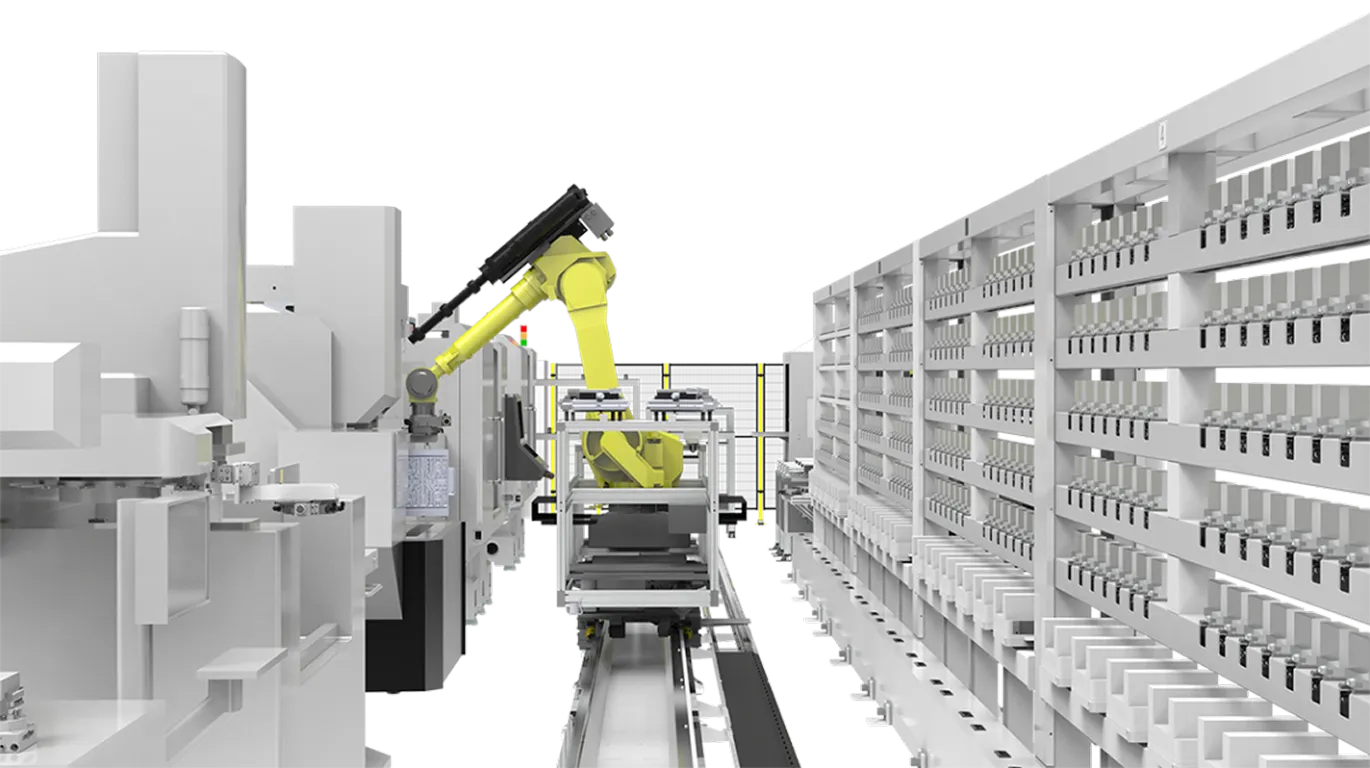
Flexible Manufacturing System

FMS Smart Flexible Manufacturing, seamlessly handling low-volume and diverse production, operating efficiently 24/7.

Is Your Factory Suitable for FMS Implementation?

Factories with High-Value CNC Equipment
Expensive equipment cannot afford downtime or wait times. FMS enables machines to operate for extended periods, including nights and holidays, improving return on investment.
Mold Manufacturing Factories
Mold processing involves long durations, multiple steps, and high tool consumption. FMS can manage continuous long-term machining, tool life, and nighttime automation, making it the most effective solution for improving utilization in mold factories.
Factories with High-Mix Low-Volume Production
Many product types, small batches, and frequent changeovers. FMS's work order decomposition and rapid scheduling make HMLV production efficient and stable.
Factories Requiring Complete Set Machining in One Go
FMS can sequence part processing according to kit logic, allowing the entire set to be completed in a single workflow for more accurate delivery.
Factories Facing Labor Shortage or Difficult Night Shift Maintenance
Manual loading, tool compensation, and confirmation processes are unstable. FMS allows unmanned production during weekends and night shifts, keeping machines running.
Factories That Cannot Accept Mid-Process Line Stops
FMS automatically checks tools, materials, and fixtures before production starts to avoid mid-process stops; combined with full line transparency for easier management.
Industries Involving High-Value, Precision Component Machining
Such as AI server liquid cooling parts, aerospace, medical, semiconductor, and high-end bicycle parts. FMS uses measurement feedback and tool compensation to ensure dimensional consistency, stable quality, and full traceability.
auto/flexible/pic1

What Benefits Can FMS Bring to Your Factory?

Maintain Long-Hour Equipment Operation
FMS performs automatic material changes and setups per schedule, minimizing CNC idle times for true 'always machining when powered.'
Rapid Changeover & Flexible Scheduling
Work order splitting, automatic tool/parameter switching make HMLV and mixed-line production simple and highly efficient.
Achieve Higher Output With Less Labor
Loading, tool compensation, measurement, logging, and rejection isolation are all automated, drastically reducing reliance on operators and night shifts.
Complete Sets Processed in One Pass
FMS sequences multiple items per kit logic, enabling simultaneous completion for higher delivery accuracy and shipment completeness.
Stable Quality, Consistent Precision, Complete Traceability
Combining measurement feedback, automatic tool compensation, and process control to ensure high-precision products maintain consistency during long-term machining.
Improve ROI of Expensive Equipment
Increased output, reduced downtime, reduced labor, and stable quality all accelerate CNC investment payback.
Avoid Mid-Process Stops and Unexpected Downtime
Pre-operation automatic checks for materials, tools, and fixtures, with automatic abnormality isolation during production to keep machining uninterrupted.

FMS System Architecture and Core Competencies

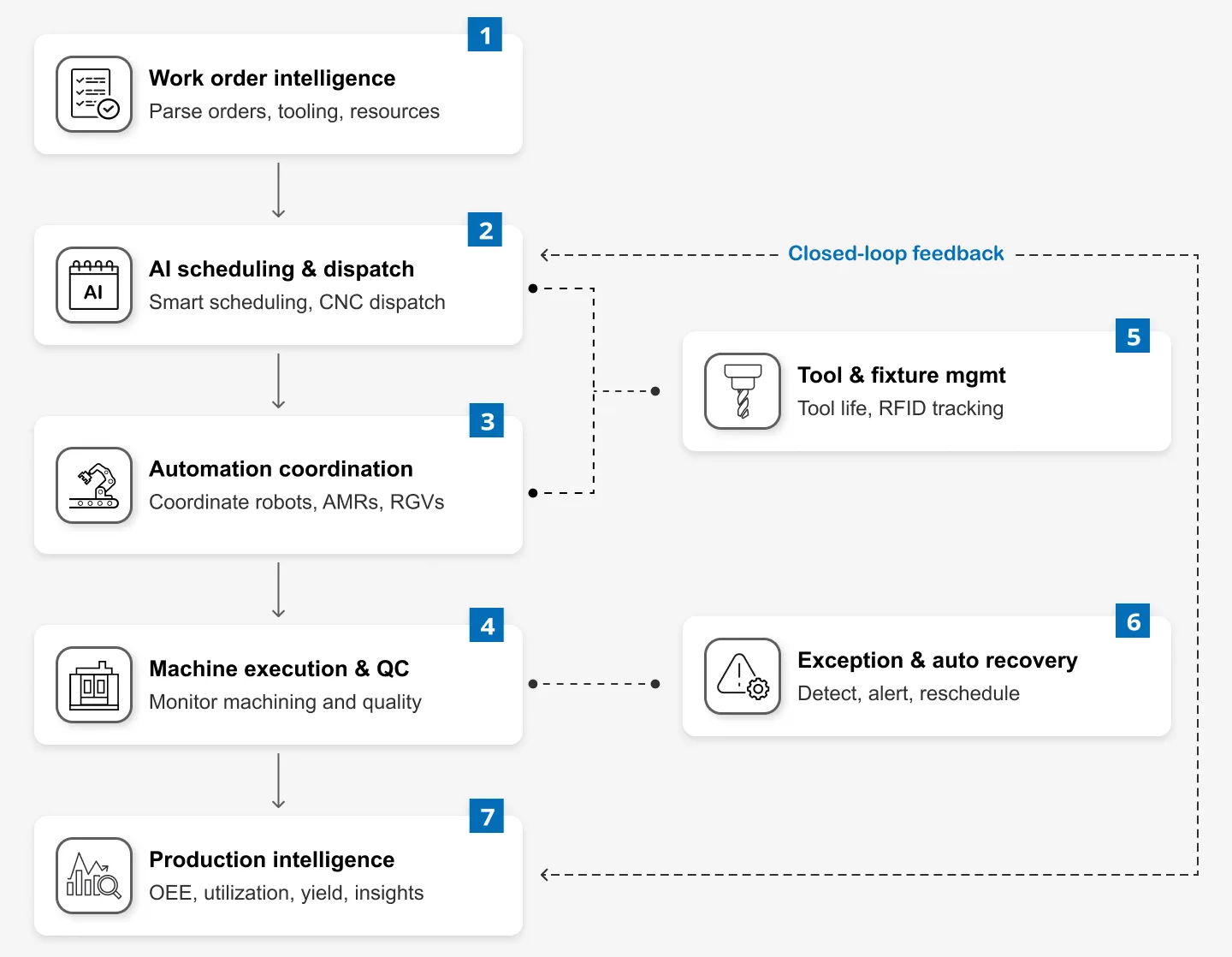
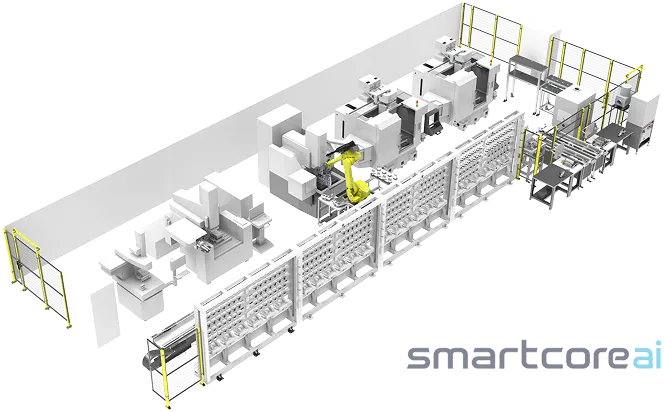
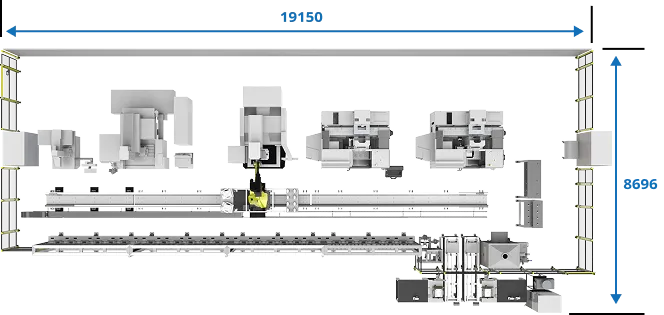
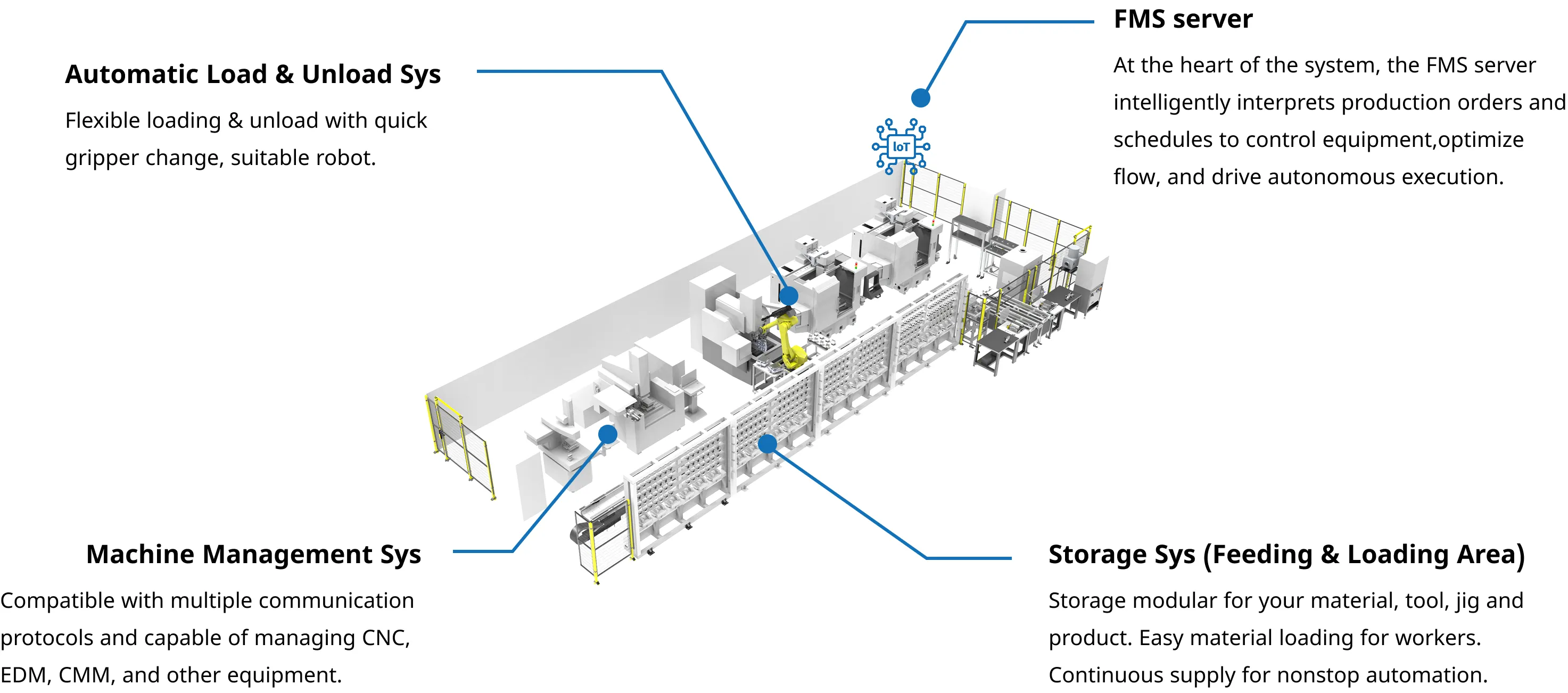
Our FMS system operates with a workflow of'Work Order Data → FMS Server → Scheduling and Program Issuance → Human-Machine Collaborative Material/Part/Tool Preparation → Automated Machining and Inspection → Finished Product Storage Management',supplemented by data monitoring and user-friendly interfaces to achieve full automation from order to shipment, ensure fast recovery from anomalies, and output data for production summary.

auto/flexible/pic2_m
  • Work Order Data

    Receive work orders and automatically decompose machining steps, tool, and material requirements.

  • Scheduling and Program Issuance

    Automatically schedule based on equipment status and priorities, issuing CNC programs to machines.

  • Automated Collaboration

    Operators, robots, and automated load/unload systems prepare production materials in advance.

  • Machining, Inspection, and Quality Feedback

    Machines process automatically per schedule, reporting status, tool info, and progress; measurement results are also returned automatically to decide Pass, Rework, or NG isolation.

  • Finished Product Storage Management

    Finished products are placed in appropriate storage locations, prompting operators for timely removal.

  • Anomaly Management and Rapid Recovery

    Detect equipment, tool, or quality anomalies, and auto-adjust schedule or issue alerts.

  • Data Monitoring and Production Summary

    Provide machining status, yield, utilization, and reports for production optimization.

Technical Specifications

auto/flexible/pic3
auto/flexible/pic4
1

Control and System Architecture

  • IPC or HA high-reliability architecture
  • Configurable per customer IT and system stability requirements
  • Integrable with MES systems
2

Machining Equipment Integration

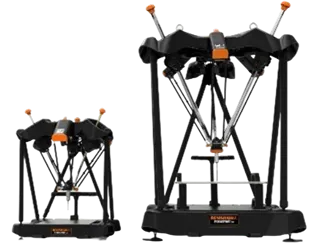
  • CNC, EDM, CMM
  • Cleaning machine
  • Load/unload workstation
3

Automatic Tool/Fixture/Gripper Changes

  • Automatic tool change and replenishment
  • Fixture and robot gripper automatic exchange
  • Supports mixed-line products and rapid switching
4

Warehouse & Material Management

  • Unified storage of tools, fixtures, and material
  • Real-time visual status
5

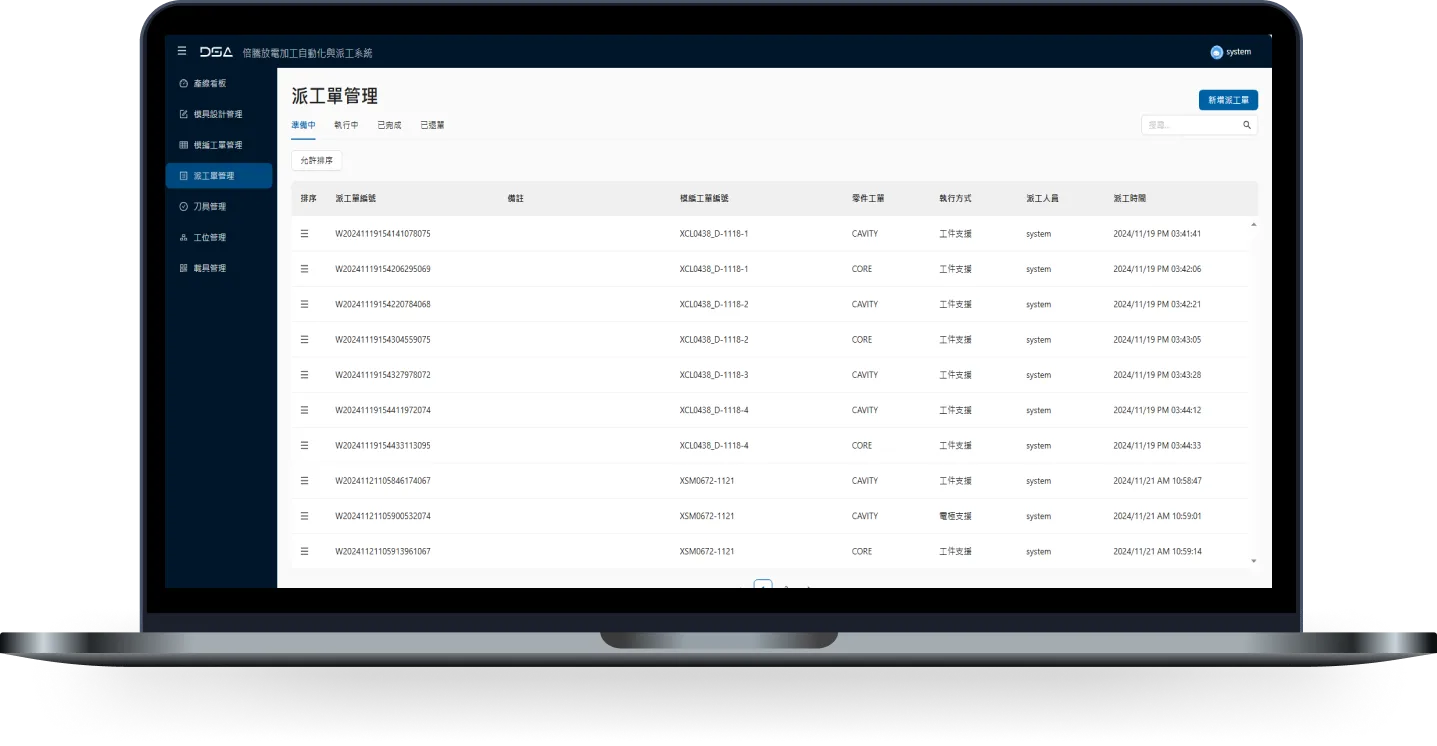
Work Order & Intelligent Scheduling

  • Work order-driven multi-machine/process scheduling
  • Real-time scheduling per equipment status and capacity
6

Automated Logistics

  • Flexible configuration per load and application needs
  • Industrial robots
  • Fork-Type RGV (Rail-Guided Vehicle)
auto/flexible/pic5

Work Order Data

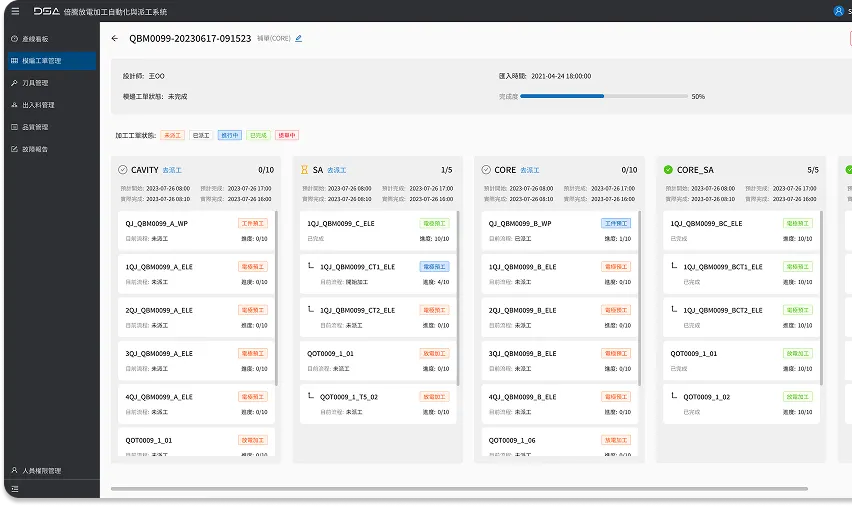
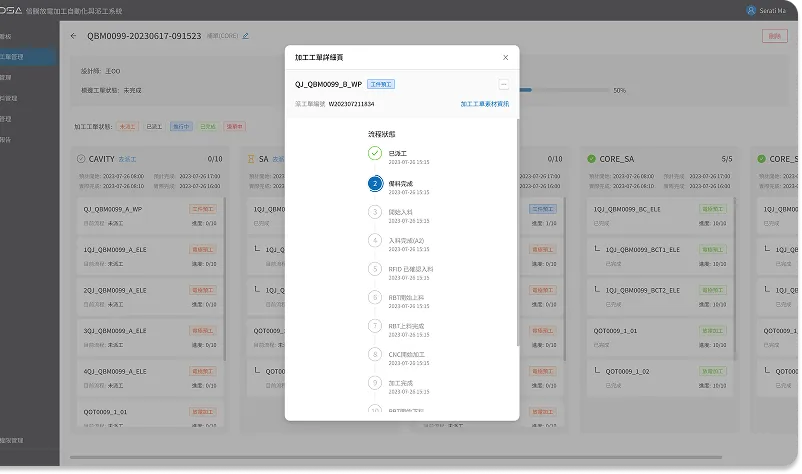
After work order import, the system expands component and part requirements. Users specify processing equipment and confirm material, tool, fixture, and procedure completeness to ensure executable work orders.
  • Component/Part Expansion
    Convert work order into a component and part list, including machining routes and process requirements for each part.
  • Assign Processing Equipment
    Users select CNC, EDM, or other machines as needed (not automatic system determination).
  • Material and Blank Check
    Confirm material type, blank size, batch, and quantity to prevent scheduling issues due to errors.
  • Tool and Fixture Resource Confirmation
    Check tool life, backup tools, fixture specs, and clamping conditions for process compliance.
  • Pre-processing Determination
    Confirm necessity for washing, degreasing, fixture positioning, tool offset setting, or initial piece measurement.
  • Work Order Integrity Check
    Verify that process, equipment, material, tool, and workflow are fully set to ensure execution readiness.
  • Warning and Blocking Mechanism
    If shortages or incompleteness in materials, equipment, tools, or workflow occur, the system warns and blocks from scheduling.
auto/flexible/pic6
auto/flexible/pic7

Scheduling and Program Issuance

FMS creates optimal schedules per work order, sending validated CNC/EDM programs and automation procedures to machines for continuous and stable machining.

  • Schedule Optimization
    Automate machining sequence by equipment status, process order, and priority.
  • Multi-Machine Task Allocation
    Simultaneous operation management and load balancing across CNCs, EDMs, and automation stations.
  • Machining Program Dispatch
    Send validated G-code/M-code, machining parameters, and tool offsets to designated machines.
  • Synchronized Automation Commands
    Handling, fixture switching, and cleaning station commands are dispatched in sync with schedules.
  • Program Version and Record Management
    Ensure every run uses the correct program and method, avoiding operational errors.
  • Real-time Schedule Adjustment
    Instant rescheduling and program dispatch in event of equipment failure, tool issues, or work order changes.
  • Avoid Idle Times and Gaps
    Seamlessly connect machining, handling, and cleaning per schedule for higher efficiency.

Automated Collaboration

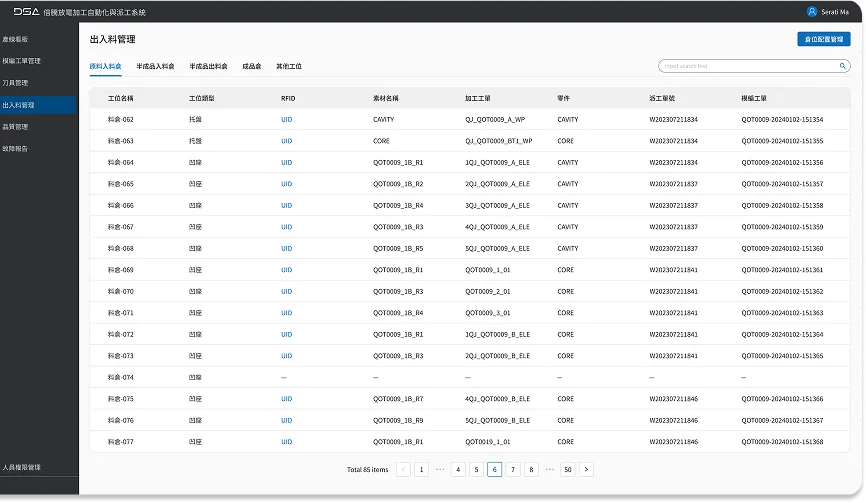
Automation uses robots, cleaning stations, tool management, and fixture switching to keep workpieces and tools continuously flowing with high efficiency and stable quality in machining and handling.
auto/flexible/pic8
auto/flexible/pic9
  • Automated Workpiece Loading/Unloading
    Robots handle grip, placement, and positioning to seamlessly connect processing stages.
  • Automated Station Transfer
    Workpieces transfer automatically between machining, cleaning, storage, and inspection stations.
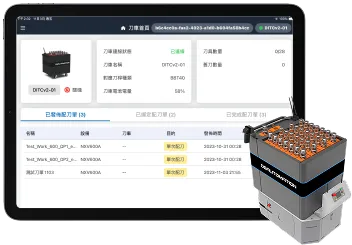
  • Tool Life Management & Auto Replacement
    Auto replacement or replenishment based on tool life to avoid downtime or dimensional errors due to worn tools.
  • Immediate Replacement for Abnormal Tools
    When broken tools, abnormal wear, or spindle load anomalies occur, execute replacement at once to reduce defect risk.
  • Automated Workpiece Cleaning Stations
    Remove oil, chips, and residue with spraying, air knife, or brushing to keep workpieces clean before the next process.
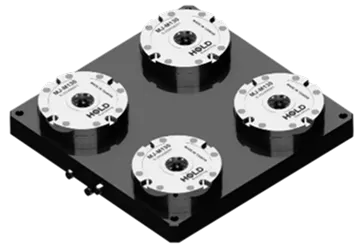
  • Automatic Fixture Switching
    Auto switch fixtures per part type, boosting utilization in multi-variety production.
  • Schedule-Synchronized Collaborative Actions
    All handling, cleaning, tool, and fixture changes are synchronized with schedules for maximum efficiency.

Machining Equipment Operation

Equipment automatically executes CNC/EDM processes by schedule, reporting real-time status, tool info, and production progress to ensure a stable and traceable process.
Start Machining per Schedule
Machines begin processing per FMS sequence, requiring no manual intervention.
Automatic Job Transition Upon Completion
After machining, automation takes over to transfer the part to cleaning or the next process.
Synchronized Execution of Machining Parameters
Automatically applies correct G-code/M-code, tool offset, fixture setting, and safety parameters.
Machine Alert & Protection Mechanism
If abnormal vibration, overload, tool breakage, or deviations happen, the machine stops immediately and reports to FMS.
Real-Time Machining Status Feedback
Reports spindle load, feed rate, vibration, machining time, and machine health in real time.
Machining Log & Traceability
All machining settings and machine logs are archived for quality traceability and order verification.
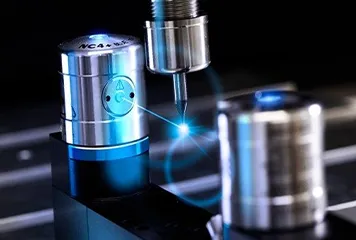
Tool Usage and Wear Monitoring
Real-time monitoring of tool wear, life, and progress, triggering replenishment or shutdown as needed.
auto/flexible/pic10
auto/flexible/pic11

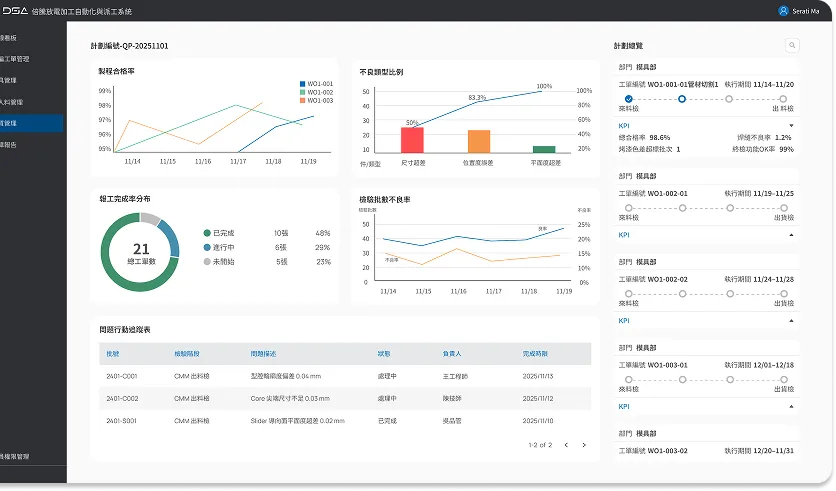
Quality Management and Measurement Traceability

Integrates CMM, optical, and measurement station data. Measurement results feed back to FMS and machines in real time, enabling full-process quality monitoring, anomaly alerts, and traceability from first piece to mass production, ensuring precision and consistency.

  • Automated Measurement Process
    Workpieces are automatically sent by robot to CMM, optical, or fixture measurement stations for inspection.
  • First Article and Process Measurement
    Supports first-article inspection and sampling to ensure consistency at both start and during process.
  • Size Feedback and Tool Compensation Adjustment
    Measurement results are fed back to FMS and pushed to the machine for tool offset correction, maintaining dimensional stability.
  • Quality Status Judgment
    System automatically judges OK/NG/Rework based on measurements.
  • Automatic NG Isolation and Flow Control
    Defective products are automatically marked and isolated to prevent them from moving to downstream processes or being misclassified as OK.
  • Abnormal Quality Alerts
    If deviations, abnormal process trends, or over-limit measurements occur, immediate alerts are issued to relevant personnel.
  • Inspection Record and Traceability
    All measurement results and decisions are recorded automatically to support traceability, reporting, and quality improvement analysis.

Anomaly Management and Rapid Recovery

The system detects production anomalies in real time and automatically adjusts schedules, replenishes resources, or switches machines, ensuring uninterrupted production and reduced quality risks through fast recovery processes.
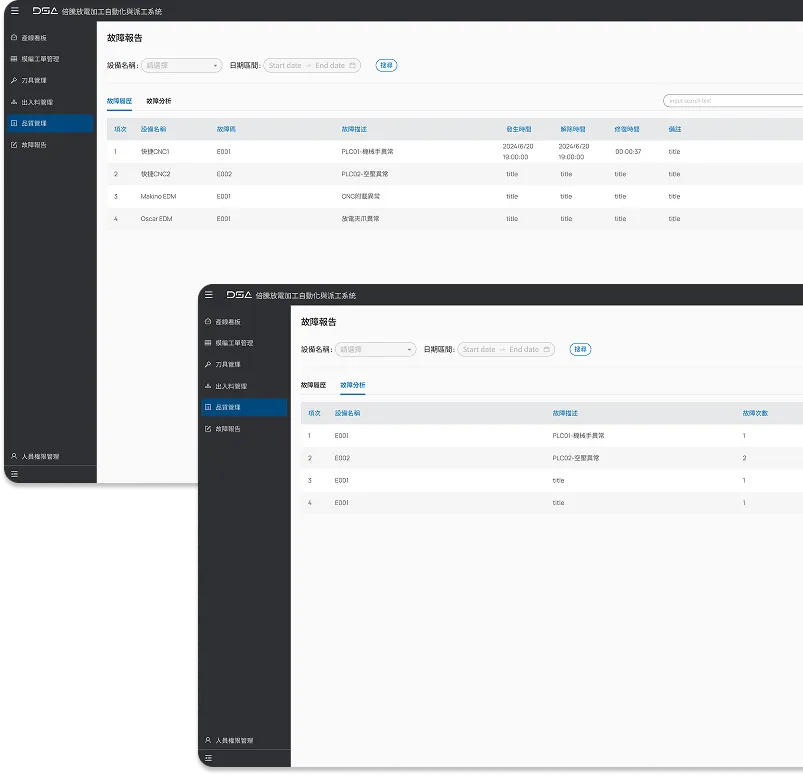
  • Work Order Cancellation and Process Termination
    When cancelled or stopped, the system immediately halts related work to avoid waste of time and resources.
  • Error Detection and Auto Correction
    The system detects logic or data errors and lets the FMS server auto-handle correction.
  • Tool/Material Anomaly Handling
    When tool breakage, end of tool life, or material shortages occur, warehouse is notified for replenishment, backup tools may be used, or tasks rescheduled.
  • Dynamic Scheduling for Parallel Machines
    If a machine breaks or is suddenly unavailable, the system dynamically reallocates tasks to alternates to keep production running.
  • Process or Program Restart
    For positioning errors, quality deviation, or machining anomalies, the system can re-run specific processes or reload CNC programs.
  • Anomaly Notifications and User Interaction
    Anomalies are immediately pushed to user interfaces, providing source diagnostics (e.g., tool, fixture, program, equipment, or material) and recommendations for quick resolution and prevention.
  • Integrated Warehouse and Fast Recovery
    Warehouse can pre-replenish materials and tools, working with automation to quickly resume flow after anomalies.
auto/flexible/pic12
auto/flexible/pic13

Data Monitoring and Production Summary

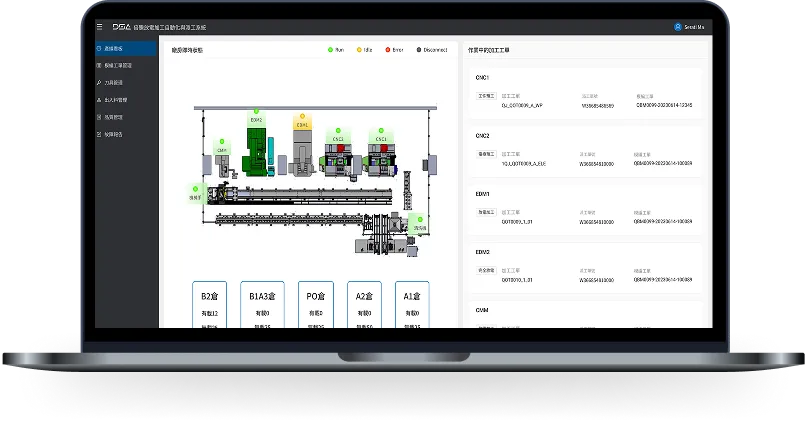
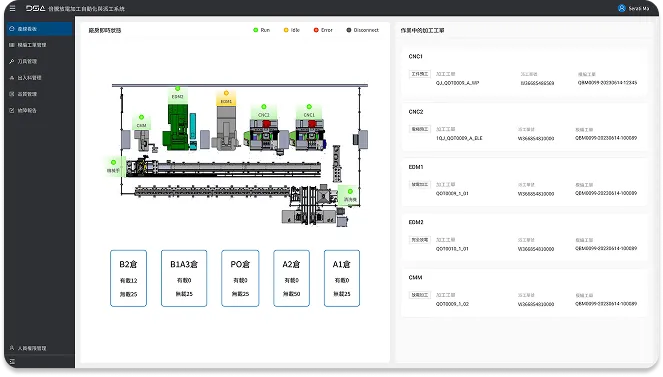
Real-time data and production reports monitor machining progress, equipment utilization, and quality, helping managers make quick decisions and optimize capacity.

  • Real-Time Production Monitoring
    Shows progress, order status, equipment load, and status of each station.
  • Equipment Utilization & OEE Analysis
    Statistics on utilization, downtime, waiting, and maintenance logs to optimize capacity.
  • Quality and Yield Statistics
    Compiles measurement results, NG counts, and trend deviations for quality stability analysis.
  • Tool and Material Usage Records
    Logs tool wear, life, replacement frequency, and material consumption to prevent sudden shortages.
  • Production Bottleneck Analysis
    Uses data to identify process, transfer, and inspection bottlenecks for cycle time optimization.
  • Automated Operation Reports
    Generates daily, weekly, and monthly reports for customer review or internal management.
  • Traceability and Historical Records
    All machining, measurement, and anomaly history is traceable and used for improvement and complaint handling.

FMS Solution: Stable Production, Efficiency Improvement, Predictable Costs

1

Reduce Labor Dependency, Stabilize Production Costs

  • Minimize manual intervention and process interruptions
  • Prevent instability and hidden costs from labor turnover or experience differences
2

Lower Downtime and Error Costs

  • Through process integration and instant anomaly handling, reduce waiting, rework, and machining errors
3

Improve Equipment Utilization and Spread Fixed Investment

  • Keep equipment truly running for long hours
  • Boost production and dilute equipment/building investment
4

Turn 'Unpredictable Risks' Into Predictable Costs

  • Comprehensive visualization of quality, process, and equipment status
  • Build management decisions on data, not just experience

© Da Shiang Technology Co., Ltd | DS Technology 2025